


Can a Cool-Girl Brand Survive Without Its Cool Girl?
By Hanna Mordekhai
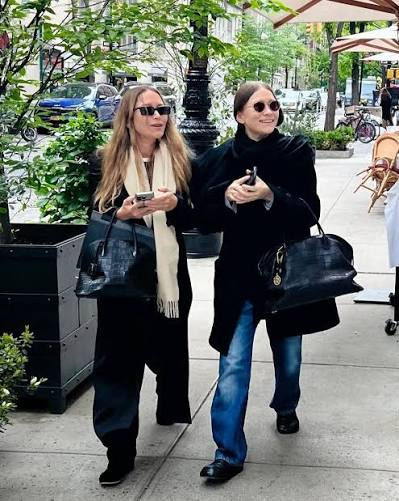
I love telling people that Michelle Tanner from Full House is behind The Row. Mary-Kate and Ashley Olsen were arguably the OG nepo brand: the kind of people everyone loves to complain have an unfair head start. And, to be fair, they did. But unlike a terrible actor who can coast on a famous last name, a fashion brand has to offer more than name recognition.
The Olsens had the fame before they had the brand. The Row had to earn its place without relying on it forever.
When the sisters launched The Row in 2006, they started with a white T-shirt. The idea was simple: if the fit, fabric, and construction were good enough, would people buy it without a logo or a famous name attached? Nearly two decades later, The Row is one of fashion’s most coveted luxury houses. The brand has grown so far past the actresses behind it that their celebrity almost feels like a fun piece of trivia. The product became the main event. British Vogue has reported on the sisters’ original focus on making the perfect white T-shirt and their belief that beautiful product should sell on its own.

It’s a useful distinction in an era when a founder’s personal brand can be built from a wedding carousel, an outfit video, or a well-timed paparazzi shot. Advertising used to sell us a fantasy through models and glossy campaigns. Now, we follow the woman behind the clothes. We know her taste, her routines, her friends, where she goes to dinner, and what she wears to Pilates. We know her commute to the office where the clothes we buy are made. We’re not just buying a product. We’re buying a little piece of her world.
And business has caught on...

Why spend millions trying to manufacture a desirable image when a founder has already spent years building one?
The celebrity founder is not a new concept, and there is nothing inherently wrong with using fame to sell a product. Attention is an asset. A founder with an audience can generate awareness that a new brand would otherwise spend years and a fortune trying to build.
The more interesting question is what happens after that first wave of attention. Can the product keep customers coming back? Can the brand attract people who don’t particularly care about its founder? And if the cool girl stopped posting tomorrow, would anyone still want what she was selling?
The face is the marketing
Hailey Bieber’s Rhode is probably the clearest example of how powerful a founder’s image can be. In 2025, e.l.f. Beauty agreed to acquire Rhode in a deal valued at up to $1 billion. Rhode had generated $212 million in net sales over the preceding 12 months. Those are serious numbers for a brand built around skincare, minimalist packaging, and Bieber’s very recognizable face and last name.
Bieber recently spoke about being “not interested in overconsumption” at Fortune’s Most Powerful Women Summit. It’s an appealing sentiment, especially in a beauty market that seems to release a new must-have product every five minutes. But I’m not convinced minimalism, by itself, explains Rhode’s success. That’s not to say Bieber is insincere about her values. It’s to say that a brand’s ethos may be a very small, arguably nonexistent part of its appeal compared with the founder’s image, the product, and the people behind the business. It would be a mistake to overlook the many people responsible for creating and growing Rhode, or the fact that Bieber herself is an extraordinarily valuable marketing tool.
The Rhode aesthetic is inseparable from Bieber’s own. Her glazed-doughnut skin, pared-back makeup, and off-duty model wardrobe helped make the brand feel like an extension of a look people were already trying to emulate. The products have to deliver, of course, but Bieber did not need to introduce herself to the market. The market was already watching her.
That is the advantage of a founder-led brand. The audience is there before the product. But it also creates a challenge: when the founder is the main attraction, how do you make sure the brand is not simply an expensive souvenir from a moment in her life?
The quiet-luxury test
Consider Sofia Richie Grainge’s SRG and Elsa Hosk’s Helsa, two brands with model founders and a retail home base in the Revolve and FWRD ecosystem.
SRG launched with Revolve and FWRD in October 2025, and its first week reportedly marked the highest first-week sales for a Revolve owned-brand collaboration launch. The collection, with prices ranging from roughly $250 to $1,850, had an audience ready and waiting. That is a successful launch. But launch-week numbers tell us about initial demand, not necessarily repeat customers.
The question is whether customers want SRG’s clothes enough to justify the price when the founder’s name is taken out of the equation. Quiet luxury is a look, not a proprietary invention. Similar silhouettes and neutral basics can be found at Zara and H&M for a fraction of the price. That doesn’t mean an expensive version cannot be worth buying. Fabric, construction, fit, and design can make a real difference. But Sofia can shop at Hermès for that level of luxury, not SRG. The brand needs to give customers a reason to choose its version beyond the fact that Sofia Richie Grainge might wear it.
Helsa offers an interesting comparison. Hosk already has fashion credibility from years of modeling, and the brand’s identity draws on the style she is known for. But a customer doesn’t necessarily have to want to be Elsa Hosk to want a Helsa coat or dress. The clothes can appeal on their own terms. Revolve has previously described Helsa drops as among its most successful owned-brand capsules, suggesting that Hosk’s audience and the product can work together.
Helsa customers are not trying to be Elsa Hosk. They know they are not the model who wore the heaviest wings at the 2026 Victoria’s Secret Fashion Show just three months after giving birth. But Hosk reaches the customer in a way that says, “Hey, I make cool clothes, I’ll keep it well priced, please buy it!” There’s something refreshing about that. She can be a supermodel and still offer clothes that feel accessible to the customer who simply likes her taste, or doesn't even know her and found it while browsing on Revolve.

Let me watch you build it
Some founders have found another way to make their personal brand work for them: they don’t just sell the finished fantasy. They let customers watch them build it.
Chelsea Parke has shared day-in-the-life content about being a fashion founder from the beginning, and she still does it today. Her audience sees the workdays, the decisions, the launches, and the process behind the product. That kind of content makes the business itself part of the appeal. Customers are not just watching someone live a life they want. They are watching someone create something, and they have a reason to care about what happens next.
According to Inc., Parke generated $16 million in revenue in 2024. The number does not prove that founder content caused the brand’s growth, but it does suggest that the model can amount to more than a social media following.
SET Active, founded by Lindsey Carter, offers a different version of the same dynamic. The brand has built a community around activewear, coordinated sets, and a particular wellness-oriented lifestyle. Customers can buy a matching set almost anywhere. What they cannot buy everywhere is the feeling of belonging to a brand’s world. When that community is strong, the founder becomes more than a face in a campaign. She becomes a person customers feel invested in.
Carter is the ultimate cool girl. She seems to know everyone in the industry, and she has fun with her clothes. What stuck out to me in particular was her pairing of a new bra top with a pair of barrel pants. Completely random, but clearly completely her own. The founder has fun with her brand, and it makes customers want to do the same. She isn't just showing people what to buy. She's showing them how to play with the clothes.
When the product gets there first

Not every successful founder-led brand relies on customers wanting to live like its founder. Some are built around a product with a distinct identity, and the founder’s world becomes an added attraction once people are already interested. And sometimes, the founder's background is part of the story, too.
Jasmin Larian Hekmat, founder of Cult Gaia, is the daughter of Isaac Larian, the billionaire behind MGA Entertainment, the company responsible for Bratz dolls. But Cult Gaia’s signature Ark bag did not become recognizable simply because of her last name. Its sculptural shape made it a fashion object in its own right, the kind of bag people could identify across a room. The brand eventually grew beyond that signature piece into clothing, shoes, and other accessories. Vogue reported that Cult Gaia reached $100 million in fiscal 2025, up from $75 million the previous year.
Sarah Staudinger, founder of STAUD, also has a life that could easily attract attention beyond her designs. She is married to Ari Emanuel, the powerful entertainment executive and former CEO of Endeavor. But STAUD has developed a recognizable contemporary design language, with pieces that feel like more than merchandise bearing a founder’s name. Both women have access to fashionable circles and the kind of social proximity that can make a brand feel desirable. Their labels also have identifiable points of view.
There is a particular appeal to these brands: the clothes and accessories get you interested, and the world around them keeps you looking. You may discover Cult Gaia because of the Ark bag and later become curious about the woman who designed it. You might buy a STAUD dress because you like its shape, then follow the brand because you want to see what it does next. Their founders' connections and backgrounds are part of the story, but they aren't the only story.
That is a healthier relationship between founder and product. The customer does not have to buy into the founder’s entire lifestyle to justify buying one item. The product is a reason to enter the world, rather than a souvenir from it.
Selling a whole lifestyle
Dairy Boy and Phe Phe show how the influencer-brand model can expand beyond a founder’s original niche, though they raise different questions about what happens when a personal identity becomes a business.

Paige Lorenze’s Dairy Boy began with a recognizable country-girl, Americana aesthetic. It has the vintage-inspired pieces, the small-town fantasy, and the feeling of being part of a particular kind of American lifestyle. Lorenze has also built a public identity around her relationships and the aspirational world of a wannabe WAG. But Dairy Boy offers her audience something more tangible than a glimpse into her personal life: a way to participate in that world themselves. You don't have to follow every detail of Lorenze's life to want a piece of the aesthetic.
According to Inc., citing a company spokesperson, Dairy Boy’s revenue increased by 160 percent from 2024 to 2025. That figure is company-reported, rather than independently audited, but it points to a brand that is growing beyond the initial novelty of its founder’s name. Its aesthetic is cohesive enough to make sense as a label in its own right. The customer can buy into the look without needing to know every detail of Lorenze’s life.
Phe Phe, founded by twin creators Brigette and Danielle Pheloung, raises a different question. The brand launched with loungewear in late 2025, then expanded into activewear, workwear, and hair accessories, including brushes and rollers. To some observers, that pace of expansion can look like a brand searching for a direction. One Reddit discussion criticized Phe Phe for having “zero brand direction,” with commenters questioning whether the founders were simply cashing in on their audience. The glamorous influencer twins may have a business that looks more like a side hustle than a single, tightly focused fashion label.
The harder question is whether those categories can live under one brand identity. A customer might happily buy loungewear, work clothes, and a hairbrush from the same company if the products share a coherent point of view. But if the only thing connecting them is that the same influencers are selling them, the brand risks feeling less like a carefully considered business and more like an ever-expanding list of things its founders can monetize.
An influencer's audience can be interested in many things. A brand cannot necessarily be all of them.
So, what happens next?
I wonder what route this new generation of brands will take. Will founders become more deliberate about building something that can stand apart from them, or will the personal brand keep expanding until almost every part of a founder’s life becomes something to sell? Will customers grow more discerning about what they buy, or will access to a founder’s world remain part of the appeal?
I don't think there's one formula. The Row started with a white T-shirt. Other brands might start with a lip treatment, a matching set, a bag, or a founder's morning routine. The interesting part is what comes after the launch, when the initial excitement settles and the brand has to decide what it wants to be.


Comments